In short
- Use a task when the job is doing, not describing. Code, a design, a hard conversation or a piece of writing shows the skill directly; a question only shows how someone talks about it.
- Pick the type from the work. Coding and whiteboard for engineers, a role-play interview for people who handle customers or colleagues, review and written tasks for anyone who checks or writes things.
- Keep it short. One or two tasks of 8 to 15 minutes, next to a few questions, fit a first round. Save longer work for later stages.
- Judge behavior, not a perfect answer. Write expectations as things you can see or hear: "asks for the order details before offering a replacement", "says when the encoding makes the text longer".
- Same task, same rules, for everyone. Job-related, no trick puzzles, and another way to answer for candidates who need one.
When a task beats a question
Ask a support candidate how they handle an angry customer and you hear a good story. Put them in a role-play interview with one and you see what they do. The same goes for engineers: describing a design is not the same as drawing one. A task gives you the work itself as evidence, in the first round, before anyone books a call.
Questions still do a lot. Structured interviews came out as the top-ranked selection method in a large 2022 re-analysis (Sackett and colleagues: a correlation of .42 with later job performance, lower than older estimates); work samples scored .33. So a task doesn't replace good questions. It is one more structured part of the interview, used where it shows something a question can't.
- Use a task when the job is mainly producing something (code, a design, an email, a review) or handling a live situation (a customer, a prospect, a colleague).
- Use a question for experience, judgment and motivation: "Tell me about a time you had to push back on a deadline." Past-behavior questions hold up well for complex jobs (Huffcutt and colleagues, 2004).
- Use both in most first rounds: a few questions to cover the must-haves, and one or two tasks for the skill you most need to see.
The seven block types at a glance
In testee an interview is a list of blocks. Each has a title, a time limit and expectations: the points a good answer covers, which only your team sees. The AI interviewer starts wrapping a block up when 80% of its time has passed. These are the types and their default times.
| Type | What the candidate does | Default time | Hidden from the candidate |
|---|---|---|---|
| Conversation | Answers a spoken question; the AI asks follow-ups | 5 min | Expectations |
| Quiz | Picks an option (or all that apply), then explains why | 2 min | Correct options, expectations |
| Coding | Writes code in a language they pick and explains it; nothing runs | 15 min | Expectations |
| Whiteboard | Sketches a design while explaining it | 15 min | Expectations |
| Role-play | Handles a situation by voice with a character the AI plays | 8 min | The character's brief, expectations |
| Review | Comments on lines of code or a document with planted problems, then talks it through | 12 min | Expectations |
| Written response | Writes an answer to a prompt, with a live word count | 10 min | Expectations |
Every type can come from the question library or be generated from a job description: see how to turn a job description into a structured interview.
Choosing the right task
Coding: a technical screening interview without a test runner
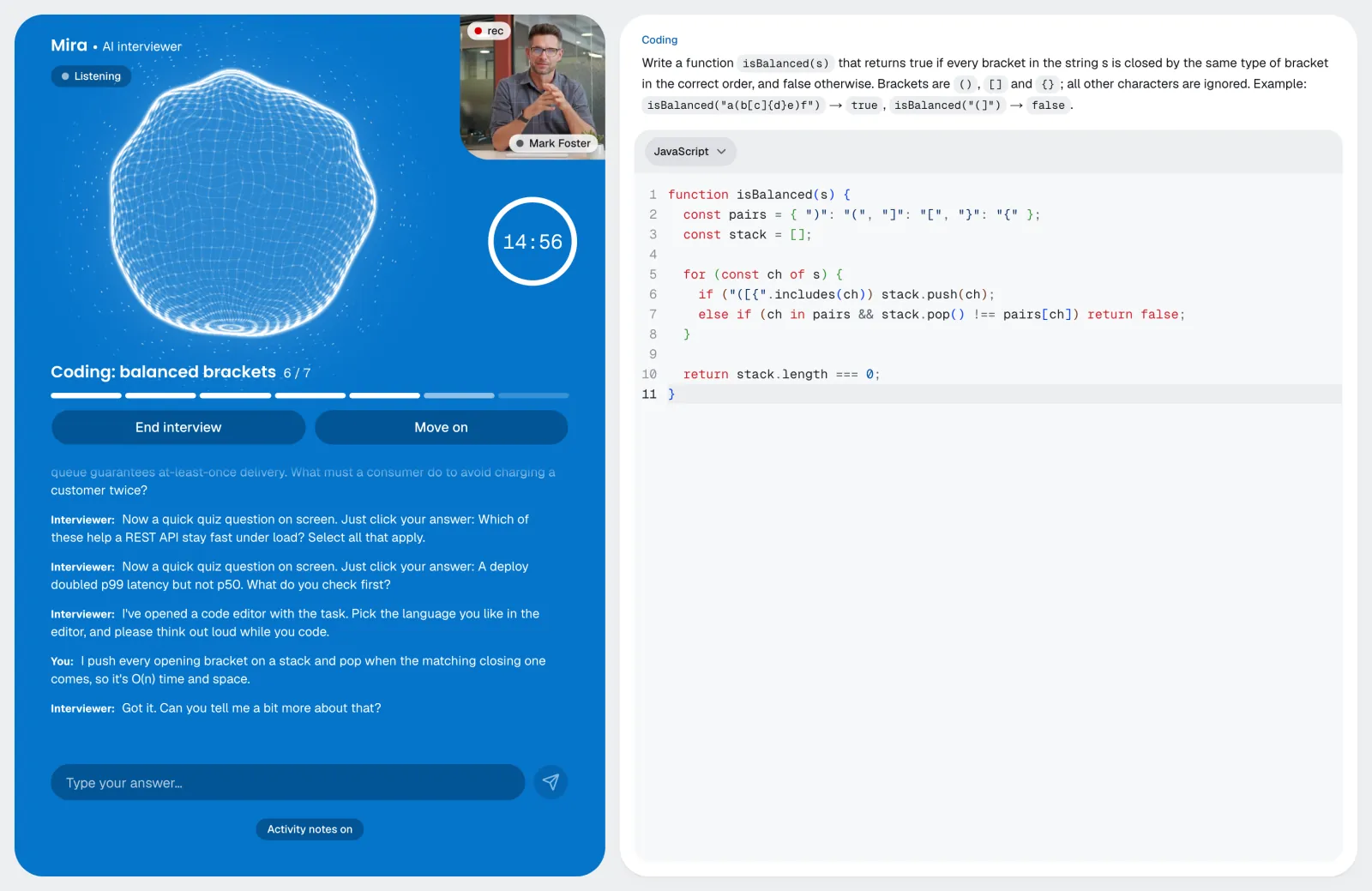
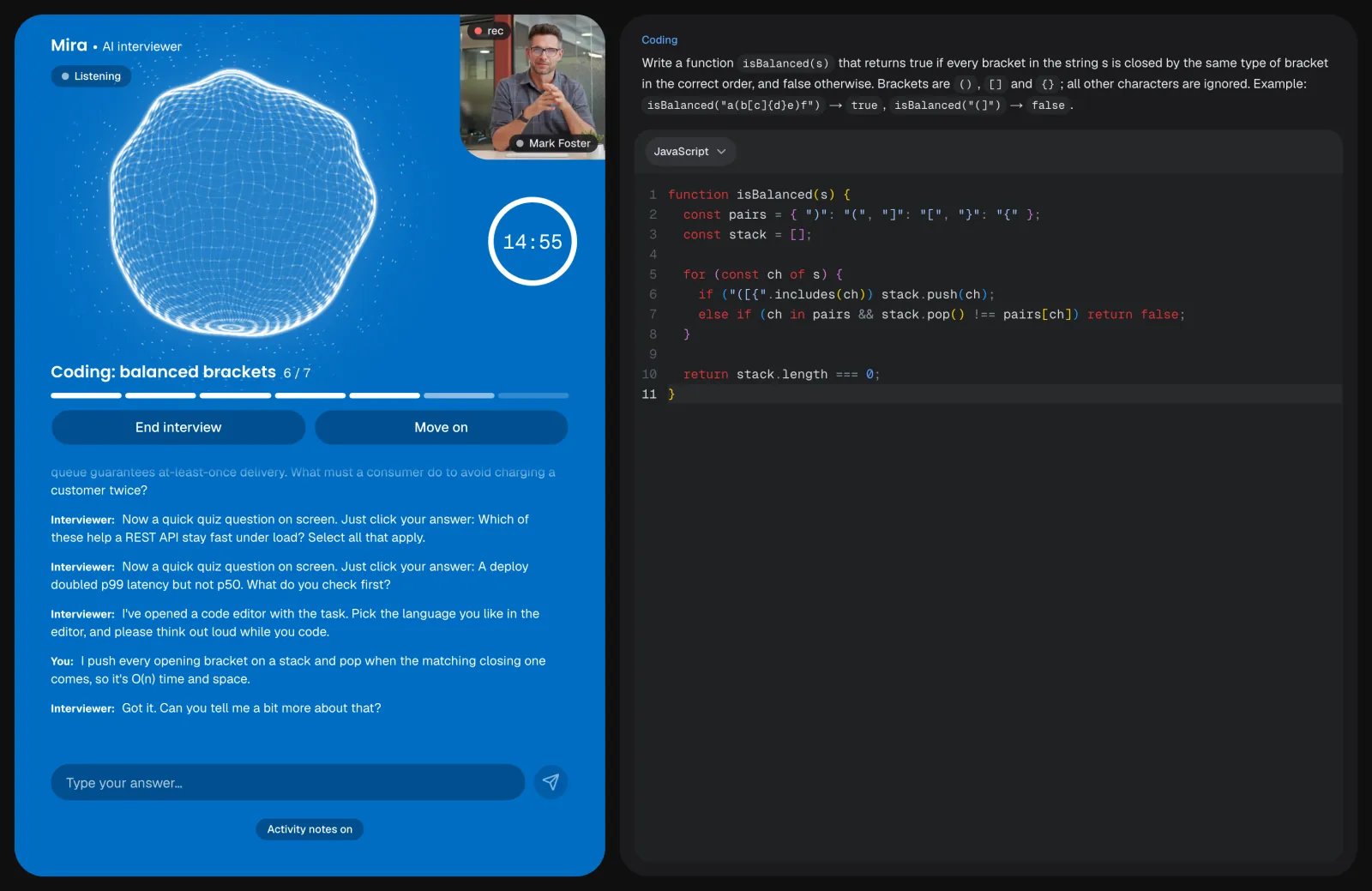
A coding block gives the candidate a task statement and an empty editor. They pick the language and write while explaining their thinking; the AI asks follow-ups such as "what would change for a much bigger input?". Nothing runs the code: the analysis reads the code and the conversation against your expectations. That makes it a good technical screening interview for reasoning, structure and edge cases, not for proving that a program compiles. Pick small, self-contained problems, such as parsing a duration string or checking balanced brackets.
Whiteboard interview: system design
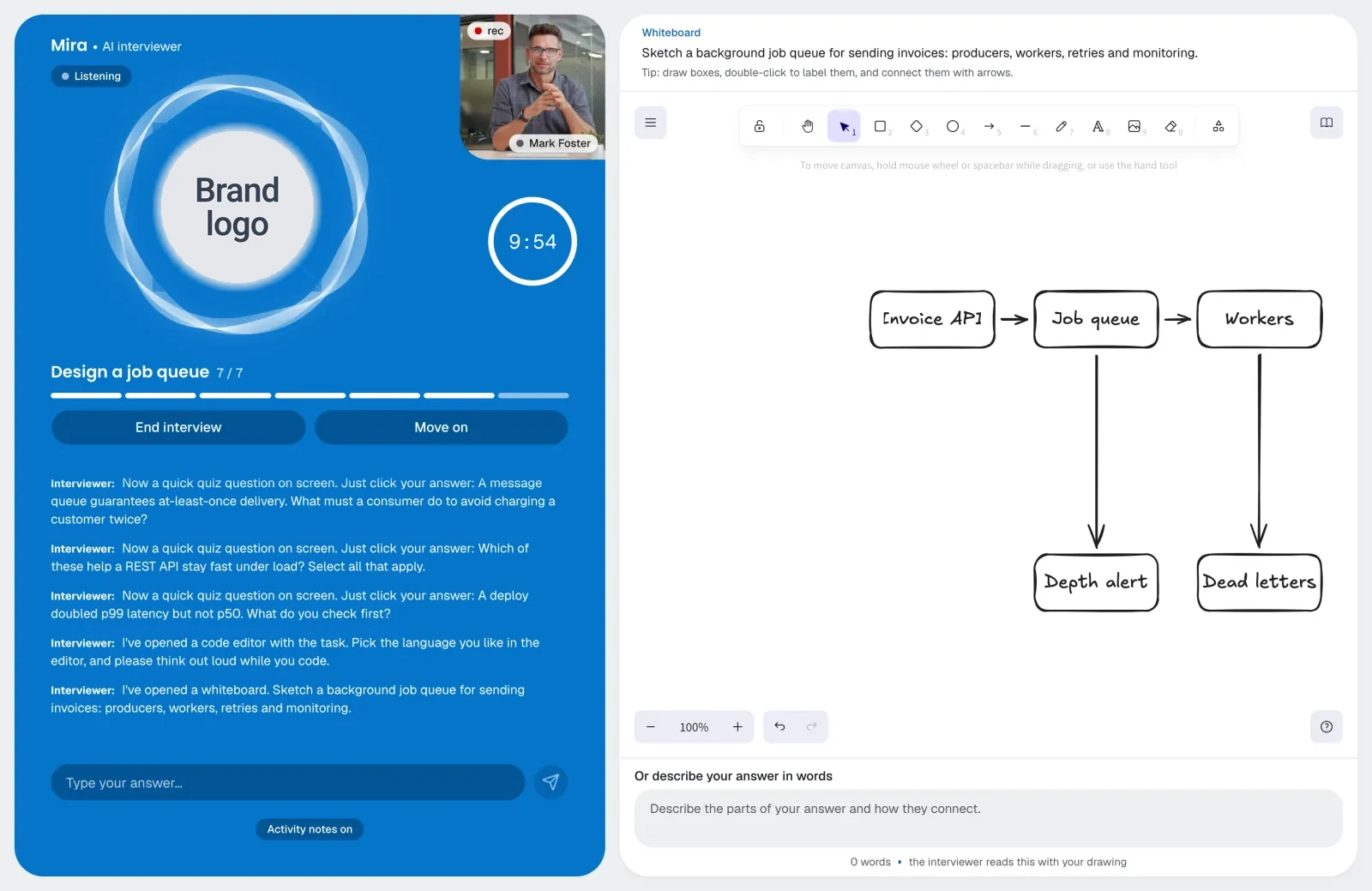
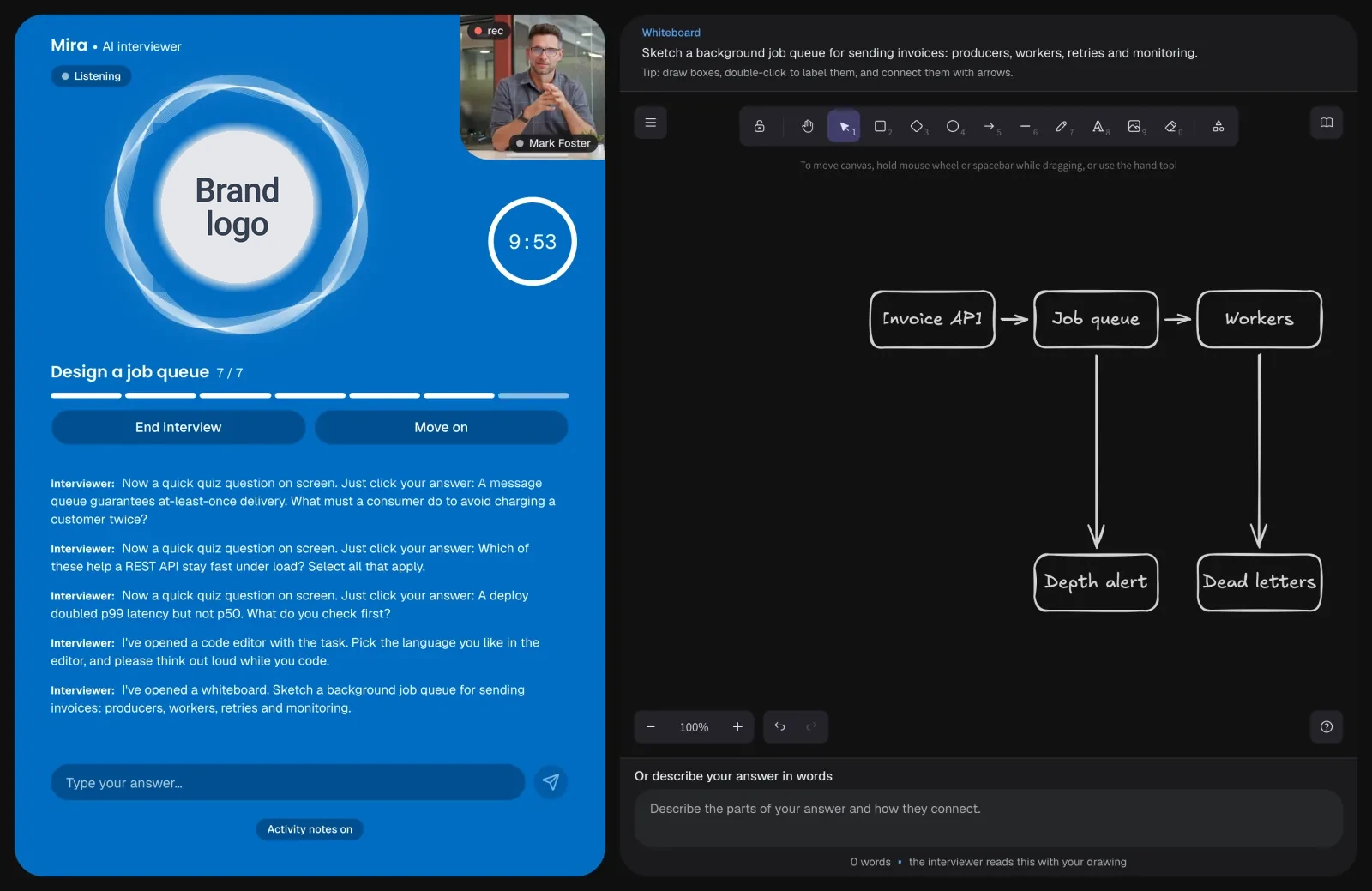
A whiteboard interview asks the candidate to sketch a design while explaining it: an API rate limiter, a notification service, a chat backend. It suits mid-level and senior engineers, where trade-offs matter more than syntax. Good expectations name the decisions; for a game leaderboard, say, "explains how the top 100 stays fast to read while scores change" and "shows on the sketch where a score update goes".
Role-play interview: a live situation
In a role-play interview the AI plays a character: an upset customer charged twice, a prospect pushing back on price, an engineer who missed a deadline. The candidate sees a scenario card with who they're talking to and the situation. The character's brief stays hidden: their mood, what they want, what they keep back unless asked, and how they react. It fits support, success, sales, product and people management. Write the brief so good behavior is rewarded: a caller who stays curt until the candidate takes ownership, then opens up. The analysis judges only the candidate's handling.
Review: find the problems
A review block shows code or a document with planted problems. The candidate comments on selected lines, then talks it through. For engineers it's a pull request; for others, a customer email draft, a requirements draft or a design document. Reviewing is often closer to the real job than writing from scratch.
Written response: a written assessment
A written response is a short written assessment inside the interview: reply to an upset customer, summarize an incident for leadership, write release notes. The candidate sees the prompt and a live word count; the word limit is guidance and nothing is cut. The interviewer stays quiet while they write.
Quiz: quick knowledge checks
A quiz is one question with options, single or select-all, followed by "why?". At 2 minutes it's the fastest block, good for knowledge a role can't do without, such as preventing SQL injection. The explanation is part of the evidence, so you can tell a reasoned answer from a lucky guess.
Sizing tasks for a first round
A first round filters; it doesn't need to see everything. Keep the interview to roughly 30 to 45 minutes, with one or two tasks. Candidates notice length: in a study of nearly 28,000 real applicants to one-way video interviews, more questions went with worse reactions (Tilston and colleagues, 2023).
| Task | Time in a first round | Keep it small by |
|---|---|---|
| Coding | 10–15 min | One function with an example |
| Whiteboard | 15 min | One system at a stated scale |
| Role-play | 8–10 min | One goal and a natural end |
| Review | 10–15 min | A page with three to five planted problems |
| Written response | 8–12 min | 200–300 words, all facts in the prompt |
| Quiz | 2 min each | Only knowledge the job needs |
An example first round for a support specialist: three conversation questions (15 minutes), the double-charge role-play (8 minutes) and a written reply to an upset customer (10 minutes). About 35 minutes, and you see listening, de-escalation and writing directly.
Writing expectations for tasks
Expectations are what the analysis checks each answer against, with quotes as evidence; candidates never see them. For a task, write them as behaviors you can see in the work or hear in the conversation, each a must-have or a nice-to-have. More in writing interview expectations.
| Task | A must-have | A nice-to-have |
|---|---|---|
| Coding: run-length encode a string | Handles a single character and an empty string without special-casing everything | Says when the encoding makes the text longer |
| Whiteboard: game leaderboard | Explains how the top scores stay fast to read while scores change | Discusses ties and players in several regions |
| Role-play: an order arrived damaged | Asks for the order details and photos before offering a replacement | Offers to arrange the return pickup |
| Written: decline a customer's feature request | Says no clearly in the first paragraph and gives the reason | Suggests a workaround the customer can use today |
- Observable, not a trait. "Stays polite when the caller raises their voice" can be checked; "is resilient" can't.
- Several good paths. "Keeps a sorted structure or another way to avoid re-sorting on every update" leaves room for other correct answers.
- Process as well as result. For a role-play, how the candidate gets there (questions asked, promises not made) matters as much as the outcome.
Example tasks by role
These are illustrations to adapt, not items from testee's library. Fit the situation to your product and customers; for whole interviews, see interview templates by role.
| Role | Task | Type | What it shows |
|---|---|---|---|
| Customer support | A customer's order arrived damaged two days before a birthday | Role-play, 8 min | Empathy, gathering facts, a clear fix |
| Customer support | Reply to a customer asking why a promised feature slipped | Written, 10 min | Honest tone, a plain explanation |
| Sales | A prospect wants to pause the deal until next quarter | Role-play, 8 min | Finding the real reason, agreeing a next step |
| Engineering manager | An engineer asks for a raise you can't give right now | Role-play, 8 min | Honesty, listening, a path forward |
| Product manager | Two teams want the same engineers for different launches | Role-play, 8 min | Prioritizing in the open, getting agreement |
| Backend engineer | Run-length encode a string | Coding, 10 min | Edge cases, clear reasoning |
| Senior engineer | Design a game leaderboard | Whiteboard, 15 min | Data structures, scale, trade-offs |
Keeping tasks fair
- Job-related. Every task should match work the person will do. If nobody in the role draws system diagrams, leave the whiteboard out.
- Same task for everyone. Candidates for a role get the same blocks, time and expectations, so results can be compared.
- Measure the skill, not the channel. A test must reflect the skill it measures, not a speaking, hearing or motor impairment (in the US, 29 CFR 1630.11). Every testee interview offers text mode, so even a role-play can be typed, and captions are always on.
- Have another way for drawing and code. The whiteboard is hard to use with a screen reader, and the code editor's accessibility mode has limits (accessibility statement). If a candidate asks, offer a conversation about the same design or a live session.
- Computers for tasks. Coding, whiteboard and review tasks work best on a computer; candidates on a phone get a heads-up and can email themselves the link.
What not to do
- No take-home marathons. A first round is not the place for a weekend project. Long unpaid work drives good candidates away, especially those with less free time.
- No trick puzzles. Brain-teasers test whether someone has seen the trick, not whether they can do the job. Use a real problem from the role, simplified.
- No missing facts. Put everything a candidate needs in the task: the limits they can offer, the scale to design for. Only the character's brief and the expectations stay hidden.
- No single right answer. Expectations that accept only one solution penalize candidates who solve it another way.
- No "all tests pass". Nothing executes the code, so judge the approach, the edge cases and the explanation.
Summary
Adding a task to your first round
- Find the skill a question can't show and pick the block type that matches the work.
- Size it: one or two tasks of 8 to 15 minutes, the whole interview around 30 to 45.
- Write three to seven expectations as behaviors, with room for more than one good answer.
- Check it's fair: job-related, the same for everyone, another way to answer for those who need it.
Questions and answers
What is a whiteboard interview?
A task where the candidate sketches a solution, usually a system design, while explaining their decisions. It shows how they break a problem down and weigh trade-offs.
What are examples of role-play interview scenarios?
A customer who was charged twice, a prospect pushing back on price, a one-to-one with an engineer who missed a deadline, a stakeholder asking for more scope, a vendor renewal at a higher price, or an escalation from an enterprise customer whose staff can't sign in.
What is a technical screening round?
An early interview that checks the technical basics before a longer technical interview: a small coding task, a few knowledge questions or a short design discussion.
What is a written assessment in an interview?
A short piece of writing on a realistic prompt, such as a customer reply, an incident summary or release notes. It shows clarity, tone and judgment.
Does testee run the candidate's code?
No. The candidate writes code and explains it, the AI asks follow-ups, and the analysis reads the code and the conversation against your expectations.
Sources
- Sackett, Zhang, Berry & Lievens 2022, Revisiting meta-analytic estimates of validity in personnel selection
- Tilston et al. 2023, asynchronous video interview design and applicant reactions
- Huffcutt, Conway, Roth & Klehe 2004, situational and behavior description interviews
- ADA regulations, 29 CFR 1630.11 (tests that reflect the skill measured)
- testee accessibility statement
- testee features