In short
- It's a legal duty, not a favor. In the US, UK and EU, employers must adjust the hiring process for disabled candidates, and that includes an AI interview.
- Tell everyone how to ask. Put a contact in the invitation, decide quickly, ask only what would help (not for a diagnosis), and keep it private.
- Extra time and text mode are built in. Give +25%, +50% or +100% per invitation, as long as the interview stays within 60 minutes; any candidate can type instead of speaking, without asking.
- Have a plan B. When an AI interview doesn't fit someone, offer a live interview with the same questions and the same expectations.
- Keep the judgment job-related. The AI compares answers with your expectations and never judges emotion, accent, fluency or appearance; a person makes every decision.
Why fairness matters in an AI interview
An AI interview gives every candidate the same questions, at any time, with the same expectations. That consistency is a good start, but it isn't the same as fair. A candidate who stutters, is deaf, uses a screen reader or needs more time to process questions can be shut out by a format that works for everyone else. Interview accommodations are how you close that gap, and in most places the law requires them.
- United States. Under the ADA, a reasonable accommodation includes "modifications or adjustments to a job application process" (29 CFR 1630.2(o)), and a test must measure the skill it is meant to measure, not a sensory, manual or speaking impairment (29 CFR 1630.11). The EEOC's 2022 technical assistance on AI was removed from its website in early 2025 and was never binding; the ADA itself still applies. The Department of Justice's 2022 page on AI and disability discrimination in hiring is still online.
- United Kingdom. Section 20 of the Equality Act 2010 requires reasonable adjustments where a disabled person is at a substantial disadvantage: changing a practice, a physical feature, or providing an auxiliary aid. Recruitment is covered.
- European Union. Directive 2000/78/EC, Article 5, requires employers to take appropriate measures, where needed in a particular case, so a disabled person can have access to employment, unless that would be a disproportionate burden.
The duty sits with you, the employer. Most requests are simple to meet, and the most common ones are built into the interview.
How to offer and handle interview accommodations
Handling accommodation requests
- Tell every candidate how to ask, before the interview. Put one line and a contact in your invitation or the message you send ahead. Start from the accommodation offer template.
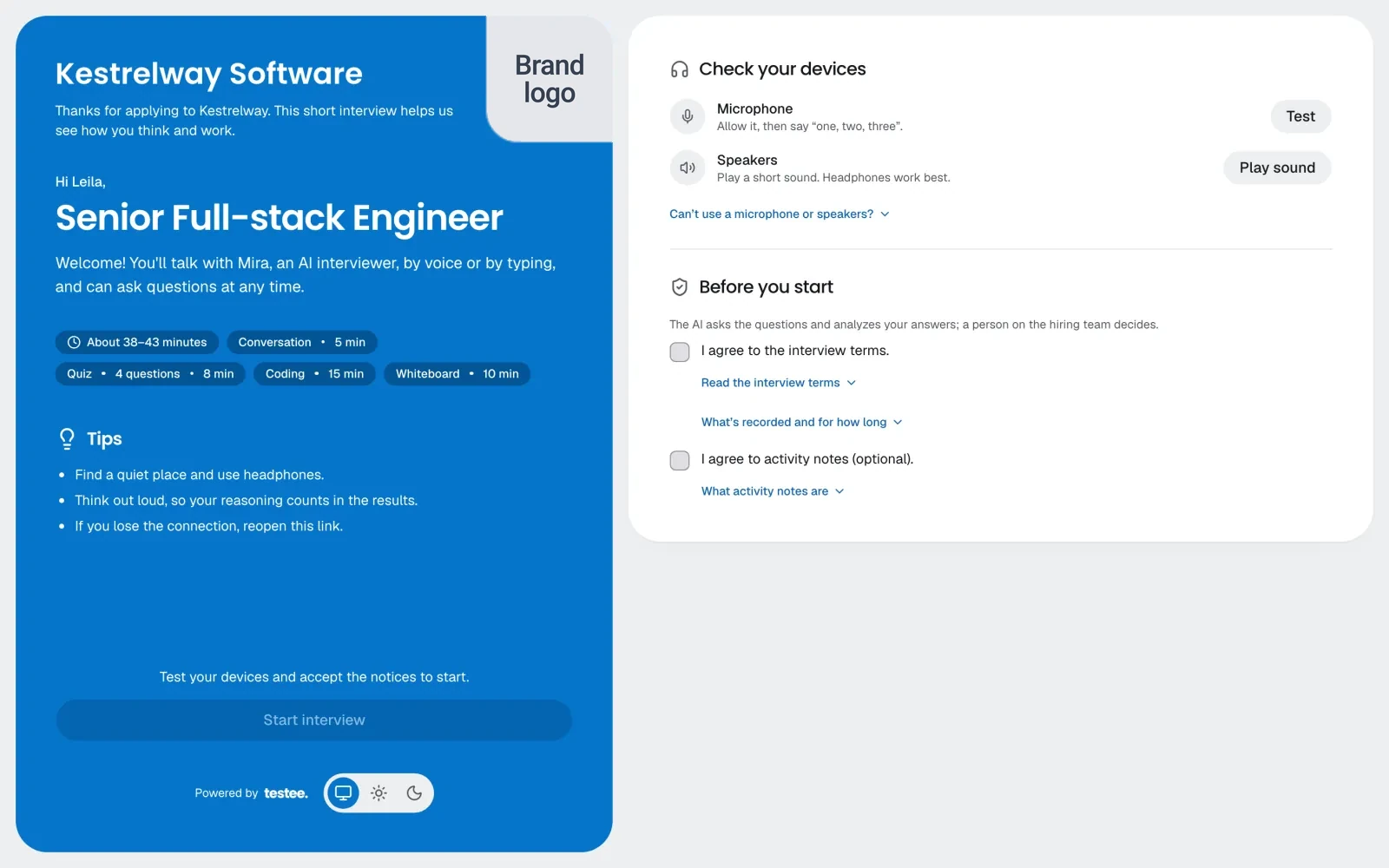
- Set the contact candidates see. In testee, Settings → Interview monitoring → "Contact for accommodations and deletion". The interview's landing page shows it on a line of its own, and the thank-you email repeats it.
- Ask what would help, not why. You don't need a diagnosis: "What would make the interview work for you?" is enough.
- Decide quickly. Reply within a few working days, before the invitation expires, or send a new link with a later deadline.
- Keep it private. Only the people arranging it should know. Reviewers don't need the reason, only what changed.
- Keep the assessment the same. Change the format, the time or the channel, not the expectations.
- Write it down. Note the request, what you offered and when. In testee every extra-time change is in the audit log.
| The candidate says | What you can offer |
|---|---|
| "I need more time to read and think" | Extra time on the invitation: +25%, +50% or +100%, within the interview's 60 minutes |
| "I stutter" or "I can't use my voice" | Text mode (they can choose it themselves); extra time if typing is slower for them |
| "I'm deaf or hard of hearing" | Captions are always on; "I can't hear sound: show captions only" on the device check; text mode to answer |
| "I use a screen reader" | Leave out the whiteboard block, or offer a conversation about the same design or a live interview |
| "I can't use a mouse" | Every control works from the keyboard; for drawing, the same alternatives as above |
| "I have ADHD, autism or anxiety" | Ask what helps: often extra time, knowing the parts and their lengths in advance (the landing page lists them), a quiet slot of their choosing, or a live interview |
| "I'd rather talk to a person" | An alternative process: see below. Where you hire in New York City, your AEDT notice must say how to ask for one |
Extra time
Extra time is one of the most common adjustments for timed assessments. It is common practice, not a fixed amount set by law: decide it with the candidate. In education research, extended time raised scores for all students, with relatively larger gains for students with disabilities (Sireci and colleagues, 2005), so give it to those who ask, not to everyone.
- Three levels: +25%, +50% or +100%. Every block's time limit grows by that share, and an interview runs at most 60 minutes, extra time included: a 45-minute interview can get +25%, a 60-minute one none.
- Set it per invitation: in the invite dialog, in the extraTime column of a CSV import, or through the API. For candidates invited from an ATS, set it on the invitation's page afterwards. You can change it until the candidate starts.
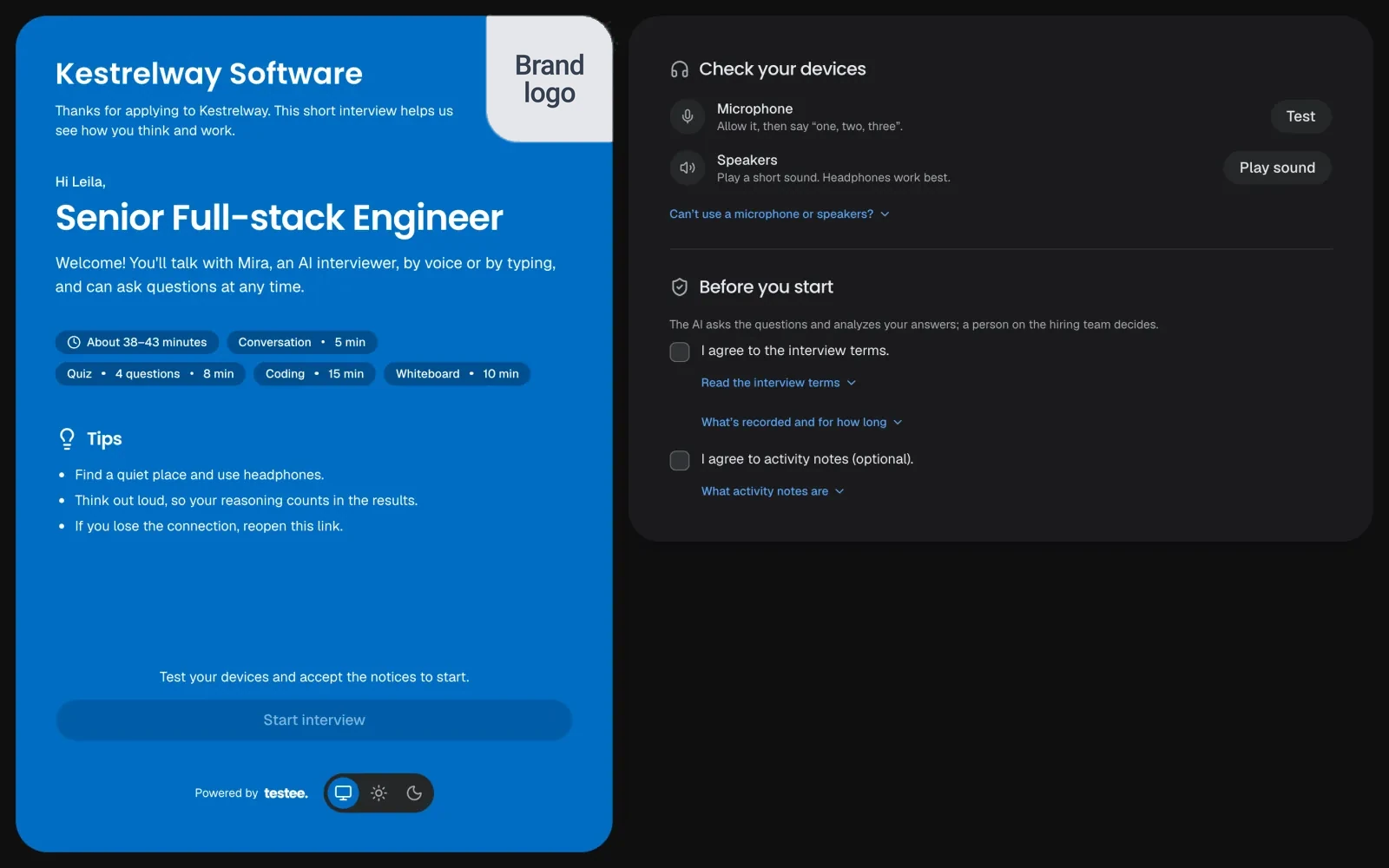
- The candidate sees longer times, not a label: the landing page shows the extended length ("About 38–43 minutes") and each part's minutes, and the room's timer and the interviewer's pacing follow the longer limits.
- Reviewers see a neutral note: the results page and the PDF show "Extra time +50%" next to the duration, so nobody reads a long interview as slow. Durations are never judged against it.
- It stays private: never in the candidate's emails, webhooks, the API's results or anything the AI reads; every change is in the audit log.
Text mode, for anyone
Every testee interview offers "I can't use a microphone or prefer to type" on the device check. Candidates choose it themselves; they don't need to ask you or explain why. The interviewer's questions still appear as captions (and can still be heard), and the candidate types every answer, role-plays included.
That covers far more than disability: a shared flat, a noisy office, a second language they write better than they speak, or simply a preference. Because nobody has to request it, nobody has to disclose anything. Say in your invitation that typing is fine.
When an AI interview doesn't fit: an alternative process
Some candidates can't use the format at all, or would still be disadvantaged with adjustments. Have a plan before you need it.
- A live interview with the same content. A person asks the same questions and judges against the same expectations.
- Another block for one part. Swap a whiteboard design for a conversation about the same system, or a written response for a spoken one.
- Name it in your notice. For jobs in New York City, the notice under Local Law 144 must tell candidates how to ask for an alternative selection process or an accommodation. Elsewhere, saying so is good practice.
- Asking costs nothing. Make clear that a request won't count against the candidate, and keep it out of the hiring decision.
AI interview bias: what the AI judges and what it never does
Candidates and regulators ask the same question: is the AI biased? No tool can promise zero bias. What you can control is what the AI is allowed to judge, how consistent the process is, and who makes the decision.
What the AI never judges
testee's analysis doesn't assess emotions, voice, accent, fluency, appearance or personality, and no AI processes video. It doesn't ask for, infer or store protected characteristics. This matters for disabled candidates in particular: a stammer, a slow typing speed or flat intonation says nothing about the job, and nothing in the analysis looks at them. Emotion recognition at work is also banned in the EU (see the AI interview compliance guide).
What it does judge
Only your expectations: for each one, whether the answer covered it, with the candidate's own words quoted as evidence. The coverage score is computed in code from those statuses and labeled "for review, not a hiring decision". If the expectations are job-related, the judgment is too; if an expectation slips in something irrelevant ("native English speaker", "high energy"), the analysis will faithfully check it. Review them with that in mind: writing interview expectations.
Controls that keep bias down
- Same questions, same expectations. Structure helps: across 31 studies, high-structure interviews showed smaller rating differences between Black, Hispanic and White applicants than low-structure ones (Huffcutt and Roth, 1998). Structure reduces bias; it doesn't remove it.
- A person decides. Advance, hold or reject is set by a reviewer, needs a note, and every change is kept. testee never rejects a candidate on its own.
- Evidence you can check. Every status links to quotes, the transcript and the recording, so a reviewer can overrule the AI when it's wrong.
- The interviewer is checked too. After each interview, an automatic review looks for our AI interviewer breaking its rules (judging or praising the candidate, revealing an answer, leaving the interview's language) and shows any findings on the results page.
- Bias audits where required. For jobs in New York City, Local Law 144 requires an independent bias audit before use and a published summary. See the compliance guide's New York City section.
Accessible interviews: what the room does and where it falls short
testee aims to meet WCAG 2.2 at level AA on the interview pages. Our accessibility statement lists what works and what doesn't yet. In short:
Works today
- Text mode: every answer can be typed.
- Captions of both speakers, always on and announced to screen readers.
- Every control works from the keyboard, with a visible focus indicator.
- The timer is readable by screen readers and turns bold when time runs low.
- Reduced motion stops the interviewer's animation; pages work with browser zoom and on small screens.
Falls short
- The whiteboard is hard to use with a screen reader.
- The code editor has its own accessibility mode, but some features are limited with screen readers.
- There's no independent accessibility audit yet; testing is by browser tests and by hand.
Plan around the gaps: if a role doesn't need drawing, leave the whiteboard out; if it does, have another way ready for a candidate who asks. Tell candidates about typing and captions before the interview, so they know before they need to ask.
Summary
A fair AI interview, step by step
- Set the accommodations contact and put it, with a line on typing and captions, in every invitation.
- Answer requests within a few working days, without asking for a diagnosis, and keep them private.
- Give extra time per invitation when asked, and let reviewers read the neutral label, not the reason.
- Have an alternative ready: a live interview with the same questions and expectations.
- Keep expectations job-related and let a trained person make every decision from the evidence.
- Check the gaps: leave out a whiteboard the job doesn't need, and commission a bias audit where the law asks for one.
Questions and answers
What interview accommodations can candidates ask for?
Common ones are extra time, typing instead of speaking, captions, a quiet time of their choosing, the structure of the interview in advance, another way to do a drawing or coding task, an interpreter, or a live interview instead. Ask what would help; a diagnosis isn't needed.
Can you get extra time in an AI interview?
In testee, yes: the company sets +25%, +50% or +100% on the candidate's invitation, as long as the interview stays within 60 minutes, and every part's time limit grows by that share. Candidates ask the company that invited them.
Are AI interviews biased?
Any assessment can be. The controls that matter are job-related expectations, the same questions for everyone, evidence a person can check, and a person making the decision. testee's AI doesn't judge emotion, voice, accent, fluency, appearance or personality, and never decides.
What accommodations help candidates with ADHD, autism or anxiety?
Ask the candidate. Frequent requests are extra time, knowing the parts and their length in advance, choosing a quiet time, typing instead of speaking, or a live interview.
Sources
- ADA regulations, 29 CFR 1630.2 (reasonable accommodation)
- ADA regulations, 29 CFR 1630.11 (administration of tests)
- US Department of Justice, Algorithms, Artificial Intelligence, and Disability Discrimination in Hiring (2022)
- Equality Act 2010, section 20 (duty to make adjustments)
- Council Directive 2000/78/EC, Article 5 (reasonable accommodation)
- Directive (EU) 2019/882, the European Accessibility Act
- W3C, Web Content Accessibility Guidelines (WCAG) 2.2
- Sireci, Scarpati & Li 2005, test accommodations and extended time
- Huffcutt & Roth 1998, racial group differences in employment interview evaluations
- NYC DCWP, Automated employment decision tools (Local Law 144)
- testee accessibility statement
- testee candidate notice templates