In short
- The coverage score is computed in code from each expectation's status, with must-haves counting double. It's for review, not a hiring decision.
- Read the must-haves line first: a missed must-have matters more than a few points of score.
- Every status has a quote. Read it, play it in the recording and change the status if it's wrong; the score follows.
- Follow-up questions and signals carry doubts into the next round. Integrity signals are signals, not proof.
- A person decides advance, hold or reject, with a note that cites the evidence.
Reading the report, not just the score
An AI interview report is only useful if your reviewers know what each part means and where it can be wrong. This guide walks through testee's results page from top to bottom (the coverage score, the must-haves line, the per-block evidence, strengths and gaps, follow-up questions, integrity signals and the team decision) and ends with a routine you can follow for each candidate.
What's in an AI interview report
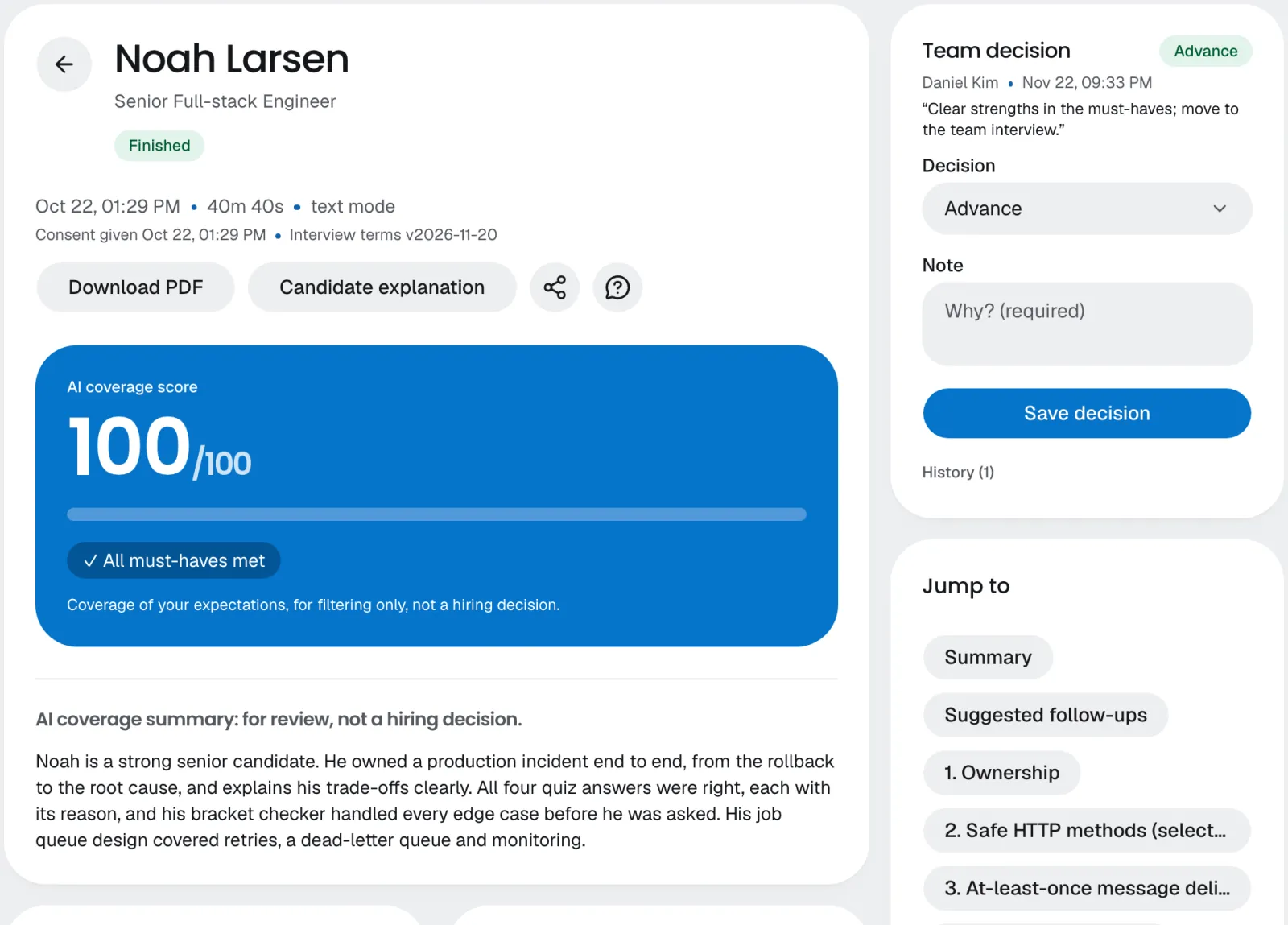
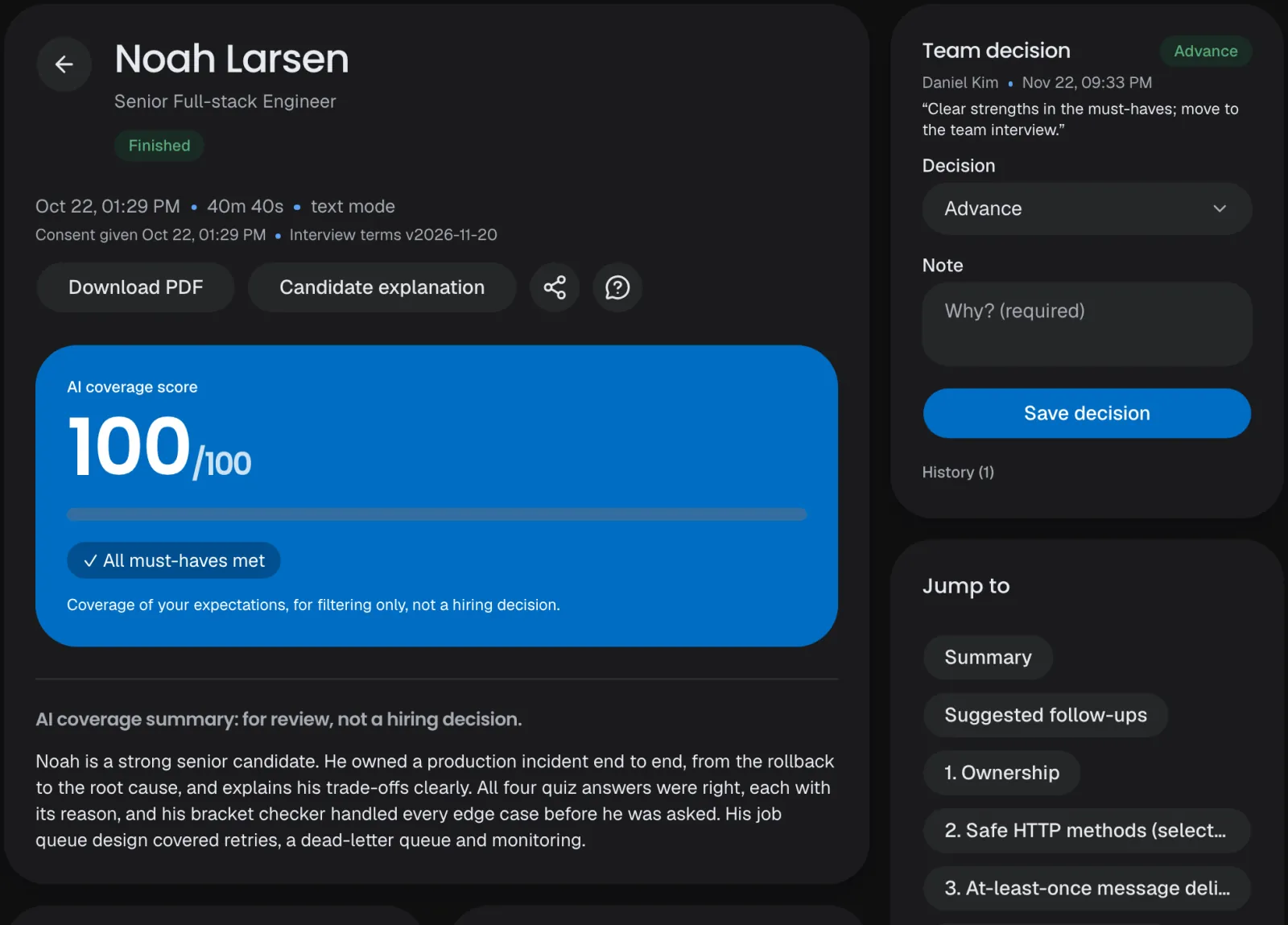
In testee the AI interview report reads from top to bottom:
- The header: the duration (with "Extra time" or "text mode" when they apply), the coverage score and the must-haves line.
- The AI summary: strengths, gaps and suggested follow-up questions.
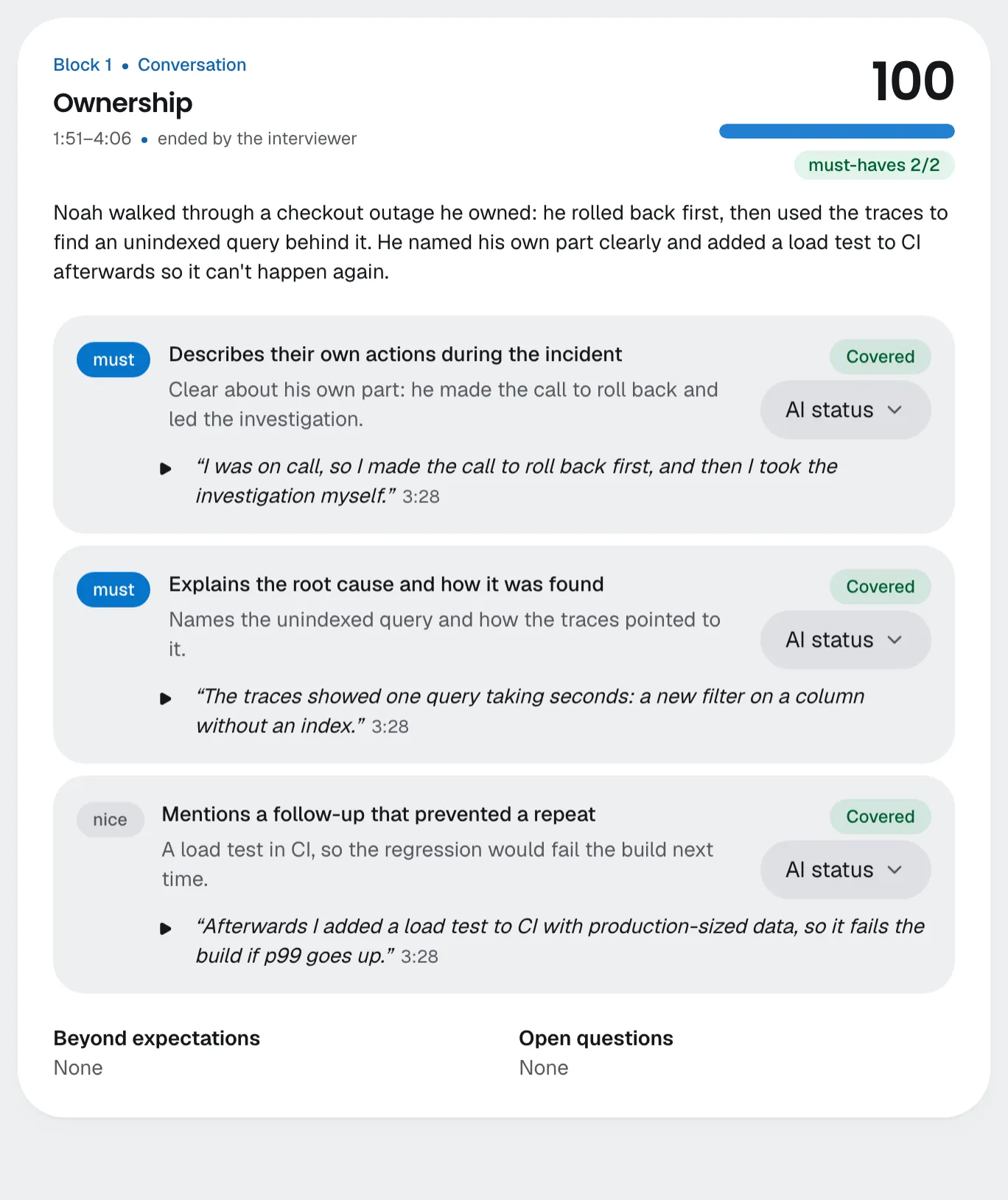
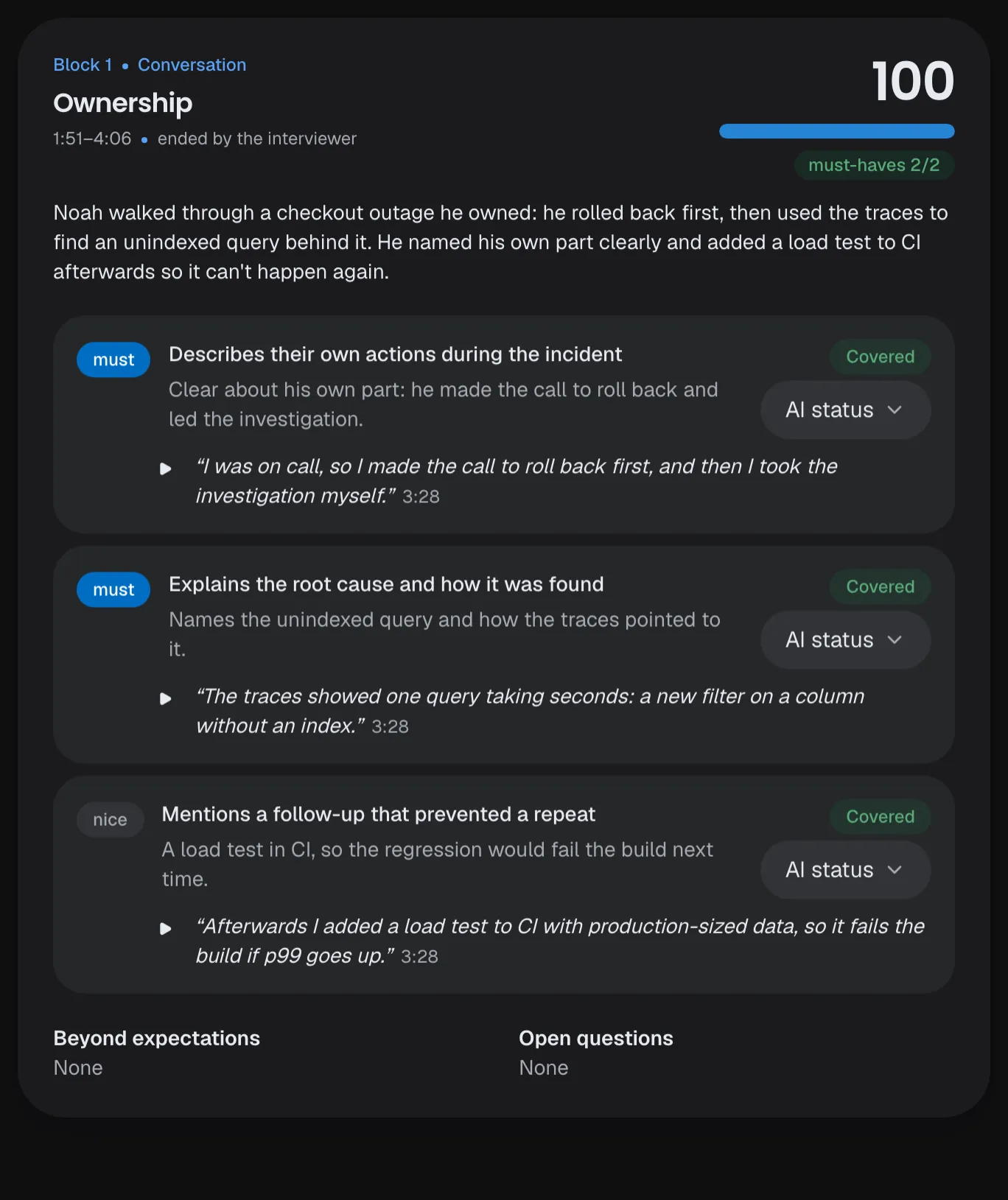
- One card per block: its own score and summary, then every expectation with its status, a note and the candidate's quote.
- Checks: integrity signals and recordings when turned on, and an interviewer review card when something was flagged.
- The record: the transcript with audio, comments, and the team decision.
The coverage score, and what it isn't
The coverage score (0 to 100) answers one question: how much of what you asked for did the answers cover? The AI marks each expectation with a status; code, not the AI, turns the statuses into the score.
| Status | Counts as | What it means |
|---|---|---|
| Covered | Full | The answer showed it, without help. |
| Partial | Half | Part of it, or only in general terms. |
| Covered after prompt | Half | The candidate got there after the interviewer gave a hint. |
| Incorrect | Nothing | The candidate addressed it but got it wrong. |
| Not covered | Nothing | It didn't come up in the answers. |
A must-have weighs twice as much as a nice-to-have. A block's score is the weighted share of its expectations, and the overall score combines the blocks by their weight.
A worked example
A customer support block asks how the candidate would handle a bug report. It has three must-haves and two nice-to-haves. The candidate covers "asks what the customer saw on screen and what they did just before" and "confirms the problem before escalating it", gives a partial answer on "keeps the customer informed without promising a fix date", covers the nice-to-have "offers a workaround in the meantime" and misses "writes the case up so engineers can act on it". That's 2 + 2 + 1 + 1 + 0 = 6 points out of 8: a score of 75.
The must-haves line
Next to the score the header says "All must-haves met" or "Some must-haves missing", and each block shows its count ("must-haves 2/3"). A must-have counts as met when it's covered or covered after a prompt; the line adds how many needed a prompt.
Read it before the number. In the example above the score is 75, yet a must-have is only partial, so some are missing. A candidate at 70 with every must-have met may fit better than one at 85 who missed one. Open the block to see why: a vague answer, a question never reached, or a transcription error.
Clear must-haves make this line useful. For how to write them, see must-haves vs nice-to-haves.
Per-block expectations: statuses and quotes
This is the heart of the interview evaluation. Each block card shows its score, summary, must-haves count and how it ended, then every expectation: must or nice, its status, a note and the quote behind it.
Check the quote, not the status
For each status that matters
- Read the quote. Does it show the expectation? "First I'd ask them for a screenshot and what they clicked" supports "asks what the customer saw on screen"; "I always try to help" doesn't.
- Play it. Click the quote to hear that moment. Transcripts can be wrong, more so with accents, speech impairments or noise.
- Read around it. The transcript shows what came before, and the block shows how many hints were logged.
- Look at the work. The candidate's code, drawing, quiz choices or text are on the card. Nothing ran the code: the analysis read it with the candidate's explanation, and so should you.
- Change what's wrong. A reviewer can set any expectation's status by hand. The card then shows both ("AI: Partial → Reviewer: Covered") and the score follows.
Blocks can also list what went beyond your expectations and open questions: material for the next round.
Strengths and gaps
Strengths and gaps digest the block evidence; they're not a separate judgment. Treat them as a table of contents: when a gap matters, open its block and check the quote. They never cover emotion, tone, accent, fluency, personality or culture fit; testee doesn't analyze them.
Suggested follow-up interview questions
Under the summary are five to eight questions for a live follow-up interview, each with a one-sentence reason and its basis: not covered, partial answer, inconsistency (two statements that disagree, both cited), take further (a strength worth exploring), or an activity note (at most two, and the question never mentions the signal).
- Pick, don't read out all eight. Choose two or three that test open must-haves and your reviewers' doubts.
- Plan them before the call. Planned, limited follow-ups keep an interview structured; unlimited probing makes it unstructured again (Levashina and colleagues, 2014).
- Ask everyone at the stage the same core questions. Add candidate-specific follow-ups on top, scored against the same expectations.
- Share them with the next interviewer. They're in the PDF and the CSV export.
Example: a candidate's answer on keeping the customer informed was partial. A good follow-up: "The engineers can't give you a fix date yet. What do you tell the customer today?"
Integrity signals, the interviewer review and extra time
Integrity signals: signals, not proof
When your company turns them on (off by default; in the EU, the EEA and the UK candidates are asked to agree first, and without their agreement the interview runs without these notes), the report has an Integrity signals card: totals, then a timeline per block with factual notes such as "Pasted 1,240 characters into the editor 3 s after the tab was hidden for 48 s". Click an event to hear that moment.
- Every signal has innocent explanations. Assistive tools, apps the candidate needs and poor connections produce the same events.
- They never change the score. There is no integrity score; signals stay out of the coverage score, the strengths and gaps, the results list, the CSV export, emails and webhooks.
- Never reject on them. Ask about the work instead: the follow-up questions include at most two drawn from notable moments, phrased about the candidate's own work.
- Close each one. Mark an event explained or dismissed, with a note. Dismissed events leave the notable count.
The interviewer review card
After each interview testee checks its own interviewer's turns. If it revealed an expected answer, praised or judged the candidate, or broke another rule, an Interviewer review card shows each flag with the interviewer's exact words. It's about the interviewer, not the candidate, and it doesn't touch the score. A candidate who was handed the answer didn't show it.
The extra time label
A candidate who asked for an accommodation may have had extra time (+25%, +50% or +100%, never past 60 minutes in all). The header shows a neutral "Extra time +50%" next to the duration. Judge the answers exactly as you would anyone else's.
The team decision, comments and sharing
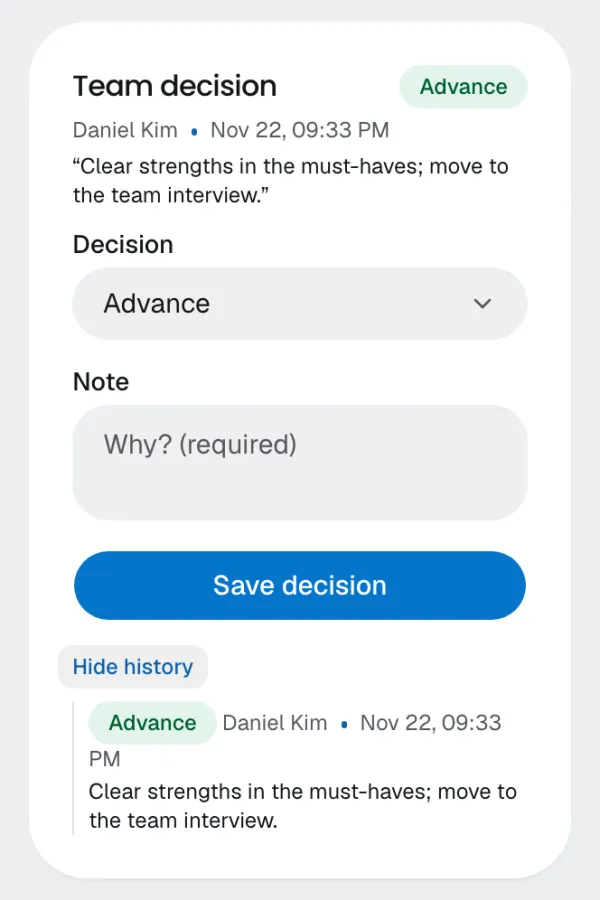
- The team decision. A person sets advance, hold or reject, with a required note; every change is kept in the history. testee never sets it.
- Write a note that explains. "Advance: covered all must-haves; bug-report answer strong (block 2). Check prioritization in the final round." Not "Score 82". The note is your record of a human review.
- Comments. Reviewers discuss a result in a thread, with replies and @mentions.
- Sharing. Download the PDF, email it to up to five people, or share a short summary in a messenger, with a link that needs a sign-in. Share only with people involved in this hiring decision: a sent PDF is outside testee and isn't deleted with the candidate.
Why evidence first, impression second
It's tempting to skim the summary and decide. Research suggests a better order. In a meta-analysis by Kuncel, Klieger, Connelly and Ones (2013), combining data by a fixed formula predicted job performance better than experts combining the same data in their heads: a mean validity of .44 against .28, even when the experts knew the jobs.
That doesn't make testee's coverage score a validated predictor: the study is about combining assessments in general. What carries over is the method: judge each expectation against its evidence, combine the same way for everyone, then add your judgment in the note. Quoting the candidate for each rating follows from research on first impressions and halo effects; it isn't a separately tested method.
A review routine in about 15 minutes
For a 30-minute interview, plan 10 to 20 minutes: a suggested budget, not a measured average. Adjust the times to the role, but keep the order.
Reviewing one AI interview report
- Header (1 minute). Must-haves line first, then the score. Note extra time or text mode so you read durations fairly.
- Summary (2 minutes). Read strengths and gaps; mark the gaps that touch must-haves.
- Blocks (6 to 10 minutes). For every must-have that isn't covered, and every status your decision depends on, read the quote and play it. Change statuses that are wrong.
- Checks (1 to 2 minutes). Read any interviewer review flags. If integrity signals are on, look at notable events with the recording and mark each explained or dismissed.
- Follow-ups (1 minute). Pick two or three suggested questions for the next round.
- Decide (2 minutes). Advance, hold or reject, with a note that cites the evidence. Disagree in comments first if you're unsure.
Summary
- The score sorts; it doesn't decide. Coverage is computed in code and is for review, not a hiring decision.
- Must-haves before the number. A lower score with every must-have met can beat a higher one with a must-have missing.
- Check the quote. Read it, play it, and change a status that's wrong.
- Signals are not proof. Review them with the recording, ask about the work, and never reject on them.
- A person decides, with a note that cites the evidence.
Questions and answers
What's in an AI interview report?
In testee: a coverage score, a must-haves line, strengths, gaps and follow-up questions, every expectation's status with its quote, the transcript and recording, and the team decision.
Does the AI decide whether a candidate gets the job?
No. The AI marks how your expectations were covered and shows the evidence; the score is labeled "for review, not a hiring decision". A person on your team sets advance, hold or reject, with a required note.
How do you check AI scores against the transcript?
Check the statuses, not the number. Click an expectation's quote to hear that moment, read the transcript around it, and change the status if it's wrong; the score follows.
What does "covered after prompt" mean?
The candidate covered the point only after the interviewer gave a hint. It counts half in the score, and it counts as met for a must-have, with the number of prompts shown next to the must-haves line.
How should I use the suggested follow-up interview questions?
Pick two or three that test open must-haves or doubts, plan them before the next round, and score the answers against the same expectations. Don't read out all of them.
Sources
- Kuncel, Klieger, Connelly and Ones (2013), Mechanical versus clinical data combination in selection and admissions decisions: a meta-analysis
- Levashina, Hartwell, Morgeson and Campion (2014), The structured employment interview: narrative and quantitative review of the research literature
- Barrick, Swider and Stewart (2010), Initial evaluations in the interview: relationships with subsequent interviewer evaluations and employment offers
- Nisbett and Wilson (1977), The halo effect: evidence for unconscious alteration of judgments
- testee, Instructions for companies
- testee, Features: review and integrity