In short
- Start from the work: read the job description for outcomes, skills and level; skip the advertising.
- Few competencies, one block each: keep the three to five skills you would reject a candidate without, each tested in the form the job uses.
- Questions with expectations: each block gets one clear question and what a good answer covers, must-have or nice-to-have.
- Fit the clock: give the must-haves the most minutes and keep it short; 30 minutes holds four or five blocks.
- The AI drafts, you check: in testee, paste a job description or a role title and a draft opens in the builder. Read every question and expectation before you publish.
Read the job description for what the job needs
Before you generate interview questions from a job description, by hand or with an interview question generator, work out what the job really needs. A job description mixes three things: the work, the requirements and the advertising. Only the first two belong in an interview.
This is a small job analysis, which the US Office of Personnel Management calls "the foundation for all assessment and selection decisions" (OPM). It pays off: in the largest recent review, structured interviews ranked first among selection methods, with a mean correlation of .42 with later job performance (Sackett et al. 2022).
- Outcomes. What must this person deliver in the first year? "Keep 60 accounts renewing" says more than a list of traits.
- Skills. What does someone do day to day to deliver them? These become your competencies.
- Level. How much do they do alone, and how complex are the problems? A junior and a senior answer should look different.
- Context. Your tools, customers and constraints make questions realistic, but a tool anyone learns in a week isn't worth interview time.
| Line in the job description | What it tells you | Interview it? |
|---|---|---|
| Own a book of 60 mid-market accounts | An outcome: retention | Yes |
| Run quarterly business reviews | A skill: showing a customer the value they get | Yes |
| Excellent communication skills | Too vague to test as written | Yes, made concrete: explains a renewal risk to a customer clearly |
| Experience with our CRM | A tool, quick to learn | Rarely; a nice-to-have at most |
| Thrive in a fast-paced environment | Advertising | No |
Turn the needs into competencies and blocks
A competency is a skill you can see in an answer: calming an upset customer, finding a slow query. The Uniform Guidelines (under revision) ask for the same link: what you measure should reflect the important duties of the job.
From needs to blocks
- Name the skill behind each outcome. Two outcomes often share one skill; merge them.
- Mark each skill essential or trainable. Essential means you would reject a candidate without it; trainable skills wait.
- Keep three to five essential skills for a first round, so each gets enough time.
- Give each essential skill a block, or two related skills one block: one question or task with its own time limit and expectations.
Pick the block type that shows the skill
Test the skill in the form the job uses it: a support agent writes replies, so a written task shows more than a question about writing.
| Block type | Use it when the job needs | Default time |
|---|---|---|
| Conversation | Judgment and experience: past situations, how they would approach a problem | 5 min |
| Quiz | A fact or concept that has one right answer, with the candidate explaining why | 2 min |
| Role-play | Handling a person: an upset customer, a prospect, a stakeholder, a report | 8 min |
| Written response | Writing the role does at work: a customer reply, a summary, a one-pager | 10 min |
| Review | Spotting problems in code or a document, such as a pull request or a draft email | 12 min |
| Coding | Writing code and explaining it; in testee nothing runs, the AI analysis reads the code | 15 min |
| Whiteboard | Designing a system or a process while explaining it | 15 min |
More on the task formats is in coding, whiteboard and role-play interview tasks.
Write the questions and the expectations
Each block gets one main question, asked the same way to every candidate. Two kinds work well: past-behavior questions ("Tell me about a time you…") and situational ones ("What would you do if…"). For complex jobs, prefer past behavior: situational questions predicted performance less well as job complexity rose, past-behavior questions didn't (Huffcutt et al. 2004).
- One thing at a time. A question asking for three things gets one answered; follow-ups dig deeper.
- Short enough to say out loud. The candidate hears it once; a written task can carry more detail.
- About the work, never the person. No questions about age, family, health, origin or anything else that isn't the job.
- Realistic. A situation from your team, details changed, not a riddle.
Then write, for each block, what a good answer covers: the expectations. Three to six per block, each one observable point, marked must-have or nice-to-have. Decide them before anyone is interviewed, so every candidate is measured against the same points. The same questions for everyone and rating each answer against set standards are among the 15 components of structure in Campion et al. 1997, and the core of the OPM's structured interview. The full method is in writing interview expectations: must-haves vs nice-to-haves.
| Weak | Better |
|---|---|
| Question: "Are you good with difficult customers?" | Question: "Tell me about a customer who was angry with your company. What did you do?" |
| Expectation: "Good communication" | Expectation: "Sums up the customer's problem in their words before proposing a fix" |
| Expectation: "Knows dates and times" | Expectation: "Stores times in UTC and converts them only for display" |
Set the time budget
Decide the total length, then give the must-haves the most minutes, and keep it short: in a study of 27,809 real applicants to one-way video interviews, more questions went with worse candidate reactions (Tilston et al. 2023).
| Length | A shape that fits |
|---|---|
| 15 min | Three conversation blocks: experience, one situation, one prioritization question |
| 30 min | An opening conversation, a role-play or written task for the core skill, and one or two more conversations or quizzes |
| 45 min | The 30-minute shape plus one review, coding or whiteboard task |
| 60 min | A technical first round: two conversations, a few quizzes, a coding task and a design discussion |
In testee you pick 15, 30, 45 or 60 minutes when you generate, and an interview can't be longer than 60 minutes. The AI interviewer starts wrapping a block up at 80% of its time limit.
Generate interview questions from a job description in testee
Generation does a first draft of all this in minutes. It doesn't replace your judgment; it gives you something to correct.
From a job description to a draft
- Start a new interview and choose From a job description, or From a role title when you have only a title such as "Senior backend engineer".
- Pick the options. Seniority (read from the text if you leave it), length (15, 30, 45 or 60 minutes), the interview language, a template whose structure to keep, and the block types. Conversation and Quiz start ticked; add Role-play or Written response when the job calls for it.
- Review the requirements. testee shows the must-have and nice-to-have skills it read from your text. Edit them first: drop a wish-list item, add what the text forgot.
- Generate. A background job writes the blocks and their expectations, then checks them: no questions about protected characteristics, nothing the candidate sees gives an expectation away, the time fits, and every must-have skill is covered. It retries once with the problems it found.
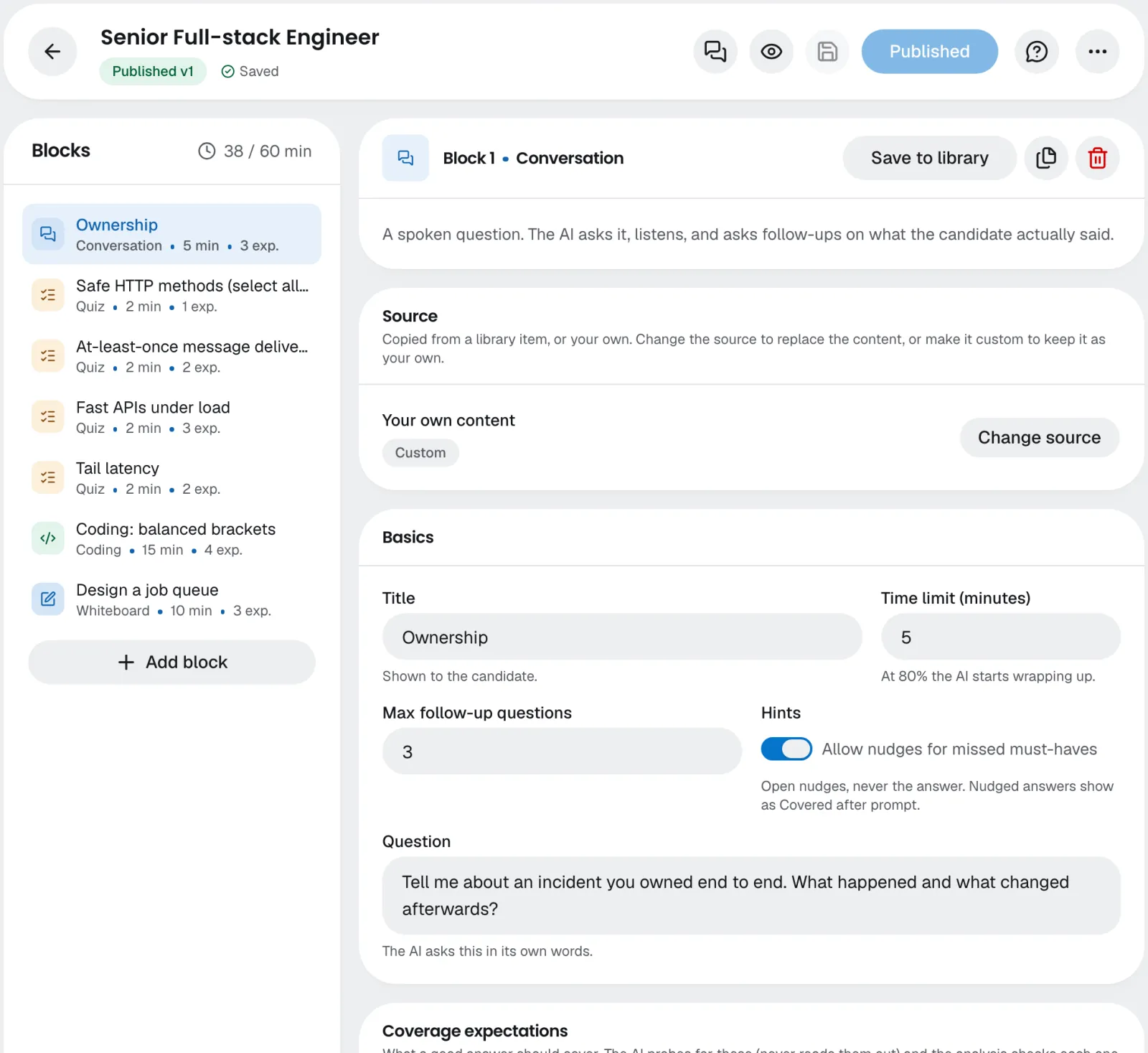
- Open the draft in the builder. A banner shows which block covers each skill. Nothing is published without a person.
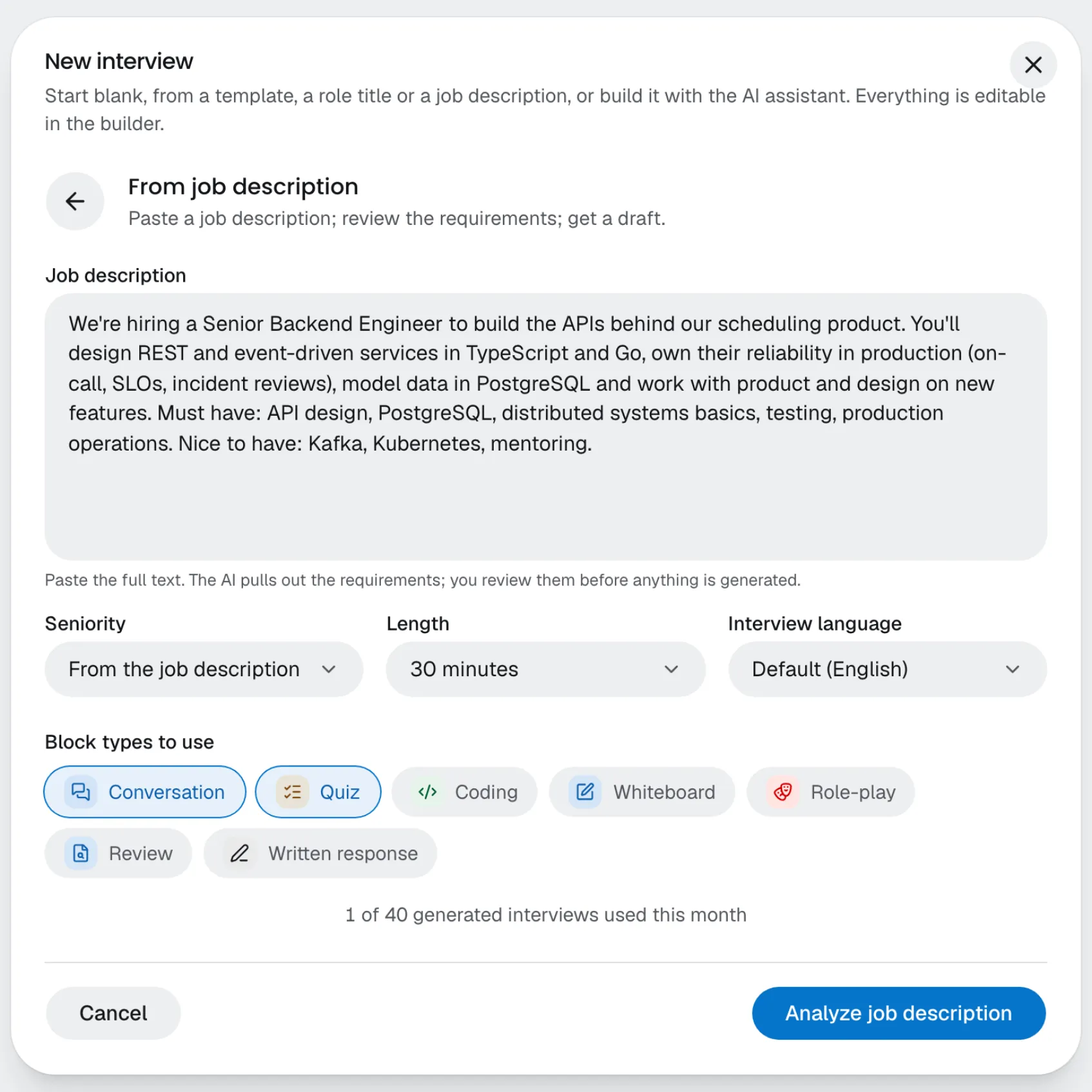
A role title alone gives only the skills the role commonly needs; paste the job description when you have one. Each generated interview counts against your plan's generated interviews (pricing).
Check the draft: the AI drafts, you decide
The automatic checks catch mechanical problems; whether a question suits your team is your call.
Before you publish
- Coverage. Does every essential skill have the block you would have chosen?
- Questions. Read each out loud: one question, clear on first hearing, about a real situation?
- Expectations. Is each observable? Would you reject a candidate who misses each must-have? Demote the rest.
- Fairness. Remove anything that rewards who someone is rather than what they can do: schools, accent, "culture fit".
- Hidden parts. Are a role-play's hidden brief and a review task's planted problems realistic for your product?
- Time. Do the limits add up, with the most minutes on the must-haves?
- Preview. Try it as a candidate before you invite anyone.
Hiring for the same role again? Save the reviewed interview as a template (Save as template in the builder's menu) and start from it next time; interview templates by role explains how.
Worked example: a customer success manager
The job description (shortened): "You'll own a book of 60 mid-market accounts, drive renewals, run quarterly business reviews, spot churn risk early and handle escalations. Excellent communication skills. Experience with our CRM is a plus. You thrive in a fast-paced environment."
Four must-have competencies come out of it: acting on churn risk early, handling an unhappy customer, preparing a business review, and clear written follow-up. The CRM is trainable and "fast-paced" is advertising, so both are left out. That gives four blocks, 28 minutes, for a 30-minute interview.
| Block | Question or task | Must-haves | Nice-to-haves |
|---|---|---|---|
| 1. A renewal you saved (conversation, 5 min) | "Tell me about an account that was at risk of not renewing. What did you do?" | Names the signals that showed the risk (usage, tickets, a sponsor leaving); describes actions they took personally; states the outcome honestly | Says what they changed afterwards to spot risk earlier |
| 2. An unhappy customer before renewal (role-play, 8 min) | Scenario: "You're the CSM for a 200-seat account. Their operations lead has asked for a call; the renewal is in six weeks." The hidden brief: two teams barely use the product and a new finance lead is reviewing tools. | Asks what's behind the dissatisfaction before proposing anything; doesn't offer a discount before understanding the problem; agrees a plan with owners and dates | Asks who else takes part in the renewal decision |
| 3. Usage drop before a review (conversation, 5 min) | "Two weeks before a quarterly business review, you see a customer's weekly active users have halved. How do you prepare?" | Looks for the cause before the meeting; plans to raise the drop openly, with a proposed next step | Ties the review to the customer's own goals |
| 4. Recap email (written response, 10 min, 200 words) | "Write the recap after a review where the customer agreed to training for two teams and to revisit the seat count in a month." | States each agreed action with an owner and a date; stays within the word limit | Restates the customer's goal in their words |
Every must-have competency has a must-have expectation, and the role-play and written task show the skill instead of asking about it.
Summary
- Read the job description for outcomes, skills and level.
- Keep three to five essential competencies, one block each, in the format the job uses.
- Write one question per block and three to six observable expectations, before anyone is interviewed.
- Share the time by importance; keep it short.
- Let generation draft it, then check it yourself.
Questions and answers
How do you use a job description for an interview?
Pull out the outcomes the person must deliver, the skills behind them and the level. Keep the three to five skills you would reject a candidate without, and write one question or task for each, with what a good answer covers.
Can AI generate interview questions from a job description?
Yes. An interview question generator can draft questions, tasks and expectations from the text in minutes. Treat it as a draft: check the skills it covers, that each question fits your team and that nothing rewards a proxy for a protected trait. In testee a person always publishes it.
What inputs give better generated questions?
The real job description rather than a title, the seniority, the length, block types that fit the work (a role-play for customer-facing jobs, coding or review for engineers) and a corrected list of must-have skills.
How many questions should a first-round structured interview have?
Enough to cover your essential skills and no more: usually three blocks in 15 minutes, four or five in 30.
Is a role title enough to build a structured interview?
For a start: testee drafts from the skills the role commonly needs at that level. Add what is specific to your team when you review the requirements.
Sources
- US Office of Personnel Management, Job analysis
- US Office of Personnel Management, Structured interviews
- Uniform Guidelines on Employee Selection Procedures, 29 CFR 1607.14 (under revision)
- Sackett, Zhang, Berry & Lievens (2022), Revisiting meta-analytic estimates of validity in personnel selection
- Huffcutt, Conway, Roth & Klehe (2004), situational and behavior description interviews and job complexity
- Tilston, Krings, Roulin, Bourdage & Fetzer (2023), asynchronous video interview design and applicant reactions
- Campion, Palmer & Campion (1997), A review of structure in the selection interview