In short
- Going blank is common and measurable. Stress at the moment of recall makes remembering harder, and anxious candidates score lower in interviews, though the anxiety says little about how they do the job.
- Part of the pressure comes from the interviewer. Interrupting, leading questions, visible reactions, rushing, off-script questions and snap impressions, mostly from untrained or hurried interviewers.
- No pressure added, more evidence out. testee's AI interviewer is designed to add no pressure of its own: no reactions, no interrupting, time to think, typing, the question again, extra time on request. It still probes for specifics, examples and reasoning.
- Proof, not impressions. Everyone gets the same questions and expectations, and reviewers see the candidate's own words for each point.
- A person decides. Use it as a fair first interview, read the evidence, and keep the later human rounds structured.
The strong candidate you almost rejected
An experienced candidate is asked about a hard problem they solved last year. They have told the story many times. In the interview, their mind goes blank: they give a vague answer and move on. On the way home they remember all of it, what went wrong, the options they weighed, the decision they made and how it turned out. The French have a phrase for the answer that arrives too late: l'esprit de l'escalier, "staircase wit", after Diderot's line about the sensitive man who loses his head and only recovers it at the bottom of the stairs.
Their interviewer scored the answer they gave, not the experience they have. This happens often enough to have names:
- Choking under pressure: doing worse than usual because the stakes are high. In lab studies, worries about the outcome take up working memory, and people with the most working memory were the ones hurt, on the problems that needed it most (Beilock and Carr, 2005).
- Test or evaluation anxiety: anxiety about being judged, which lowers scores in exams and interviews alike. A 30-year meta-analysis of 238 studies found small to moderate negative links with test results (von der Embse and colleagues, 2018).
- Going blank, or stress-induced retrieval failure: stress at the moment of recall blocks access to memories that are still there. A meta-analysis of 31 studies found a modest but reliable effect (Shields and colleagues, 2017); stress hormones were first shown to block retrieval in rats, then in people given cortisone (de Quervain and colleagues, 1998 and 2000).
In interviews, it's measurable. Interview anxiety has five sides: communication, appearance, social, performance and behavioral (McCarthy and Goffin, 2004). Anxious candidates score lower: a meta-analysis found a correlation of −.19 between interview anxiety and interview performance (Powell and colleagues, 2018), and a study of 8,343 real applicants found anxiety linked to lower interview performance (McCarthy and colleagues, 2021). Yet one field study found interview anxiety had near-zero correlations with later job performance (Schneider and colleagues, 2019). Anxiety, in other words, lowers the interview score more than it says about the work.
Where the pressure comes from
Some pressure comes with any interview: a job, money and pride are at stake. Researchers separate pressure from the outcome, which crowds working memory, from pressure of being watched, which makes people monitor themselves (DeCaro and colleagues, 2011). An interview has both.
The rest comes from the interviewer. The interviewer's manner affects how anxious candidates feel (Carless and Imber, 2007) and changes how candidates come across to independent judges (Liden and colleagues, 1993). An experienced, trained interviewer keeps that pressure low. An untrained or rushed one adds it without meaning to:
- Interrupting or filling silences. A pause is often where the memory comes back. Cutting in, or answering for the candidate, ends the search.
- Leading or closed questions. "You've handled that before, right?" gets a yes, not evidence. Structured interviews plan the questions in advance instead (Campion and colleagues, 1997).
- Visible reactions. A frown, a sigh, a glance at the clock or a quick "okay, next" tells the candidate the answer isn't landing, and the worry takes up the space the answer needed.
- Rushing. Running late, the interviewer hurries through questions and the candidate hurries their answers.
- Off-script questions. Different candidates get different questions, harder or easier, depending on the conversation and the interviewer's mood.
- First impressions. Interviewers tend to confirm the impression they already hold: in one field study, after a good first impression they gathered less information and spent more time selling the job (Dougherty and colleagues, 1994).
- Stress interviews on purpose. Some interviewers apply pressure deliberately to "see how candidates cope". We found no peer-reviewed evidence that it predicts how people do the job.
Why it costs you the best people
- Experienced candidates get mis-scored. The people with the most to recall can lose the most when recall fails. A blank moment reads as a gap in knowledge, and a strong candidate leaves with a reject.
- Inconsistent interviews predict less. In the most recent re-analysis, structured interviews predicted job performance at .42, the highest of any selection method, and unstructured ones at .19 (Sackett and colleagues, 2022). Interviewer training and standardized questions also make interviewers agree more (Conway and colleagues, 1995).
- Decisions rest on a moment. Early impressions predict the final rating (Barrick and colleagues, 2010). They're partly based on real competence, so they aren't pure bias, but a candidate who goes blank at the start has a poor impression to climb back from.
- Candidates walk away. Anxious applicants saw the process as less fair and were less willing to recommend the employer (McCarthy and colleagues, 2021).
None of this is a case against human interviewers. Trained interviewers who ask everyone the same questions and score against agreed expectations run good interviews. The problem is consistency: a company with many interviewers can't guarantee that every candidate meets one of them on a good day.
No pressure added, more evidence out
An interview is an evaluation, and an evaluation will always make some people nervous. What a company can control is the pressure the interviewer adds on top. testee's AI interviewer is designed to add none of its own, while still pressing for the specifics that show real experience.
What the interviewer doesn't add
- No reactions to read. It never says whether an answer was right or wrong, gives no praise and no "not quite", and acknowledges with a neutral "okay" or "thanks". There's no frown, sigh or glance at the clock to decode.
- No interrupting. It waits for real words before it answers: a cough, a "hmm" or a background noise doesn't count as an answer, and it waits up to about 8 seconds of silence before it takes a pause as the end of a turn. "Let me think" gets a couple of words at most, then quiet.
- No rushing. Each part has a known time limit, shown before the start and on a timer, instead of an interviewer's impatience to read. After a long silence the interviewer checks in once, offering to repeat the question.
- Ask again, any time. A candidate who lost the thread can ask to hear the task again, and the interviewer restates the whole question with its scenario, not only its last remark.
- Type instead of speaking. Any candidate can answer by typing, without giving a reason, and live captions show everything the interviewer says.
- Extra time when asked. A company can give a candidate +25%, +50% or +100% on their invitation, as long as the interview stays within 60 minutes. Every part's time grows with it, and reviewers see only a neutral label.
- A pause, or the end, when it's too much. A candidate who says they are panicking, crying or facing an emergency is offered, in one warm sentence, a short pause or the end of the interview, and is never asked why. If the connection drops or the page closes, the clock and the interviewer stop for up to 5 minutes and the candidate carries on where they left off.
- No judging the person. The analysis never assesses emotions, voice, accent, appearance or personality, so visible nerves aren't scored. Only what the candidate said and did is compared with the role's expectations.
How it still draws out proof of experience
- Follow-ups on what they said. The interviewer goes deeper on the candidate's own answer: their decisions, trade-offs and specifics, within a follow-up limit set for each part and pitched at the role's level.
- The reasoning, not only the result. In quiz, coding and whiteboard parts it always asks the candidate to walk through their answer, with an open request that doesn't list what it's looking for, and asks again where the explanation left something out.
- Room to finish and add. It asks one thing at a time and then listens. A candidate who presses Done while an explanation is still open is asked once whether they're sure, so a rushed moment doesn't close a part too early.
- Nudges that don't give the answer away. A follow-up points at an area ("What would you do differently next time?"), never at the expected answer, so what the candidate brings up is theirs.
- The same expectations for everyone. Every candidate for the role gets the same questions and is compared with the same points, written by your team before the first interview.
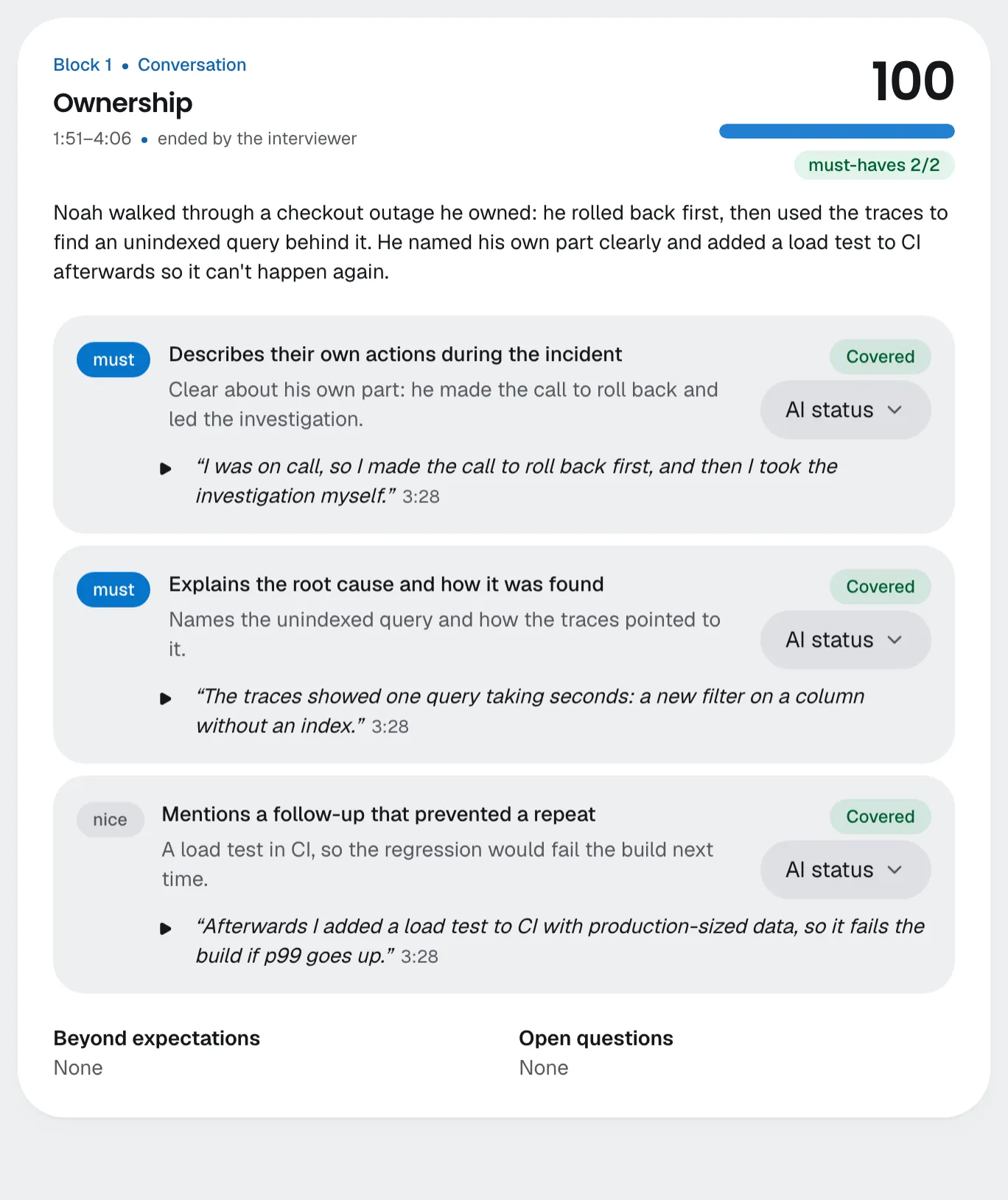
- Quotes, not impressions. For each expectation the report shows whether it was covered, with a note and the candidate's own words, which a reviewer can play back. A reviewer sees the proof of experience, not a feeling about how the conversation went.
Do AI interviews make candidates less anxious?
The honest answer is: it depends, and the research is young. A review of asynchronous video interviews called the evidence on interview anxiety "scarce" (Lukacik and colleagues, 2022), and we found no large peer-reviewed study comparing anxiety with an AI interviewer and with a person head to head.
- Some find less social pressure. People who believed a virtual interviewer was automated feared disclosure less and managed impressions less than those who thought a person was behind it, in a health screening study of 239 people (Lucas and colleagues, 2014). In a small study of 24 people, a text-based AI interviewer was valued for its reduced social pressure, though the human interviewer was trusted more (Ali and Atweh, 2026).
- Some find more unease. Recorded one-way interviews felt creepier and less personal than video calls (Langer and colleagues, 2017), and highly automated interviews came with less perceived control and lower acceptance when the stakes were high (Langer and colleagues, 2019). Candidates told an AI would evaluate them felt less certain (Liu and colleagues, 2023).
- Many people distrust AI decisions. In a Pew Research Center survey of US adults, 71% opposed AI making the final hiring decision (2023).
- The medium alone isn't the answer. One study found no difference in strain or interview anxiety between face-to-face, phone and video interviews (Melchers and colleagues, 2021).
Two things follow. Much of the unease in these studies is about being judged by a machine and losing control, so tell candidates plainly that a person decides, what is and isn't assessed, and that they can type, ask again and ask for more time. And measure your own process: candidates rate each interview afterwards, and their comments tell you whether the format works for your roles.
How to use it in your hiring
The aim isn't to replace people, it's to give every candidate the same fair first conversation and give your team evidence to decide on. A person reviews every result and makes every decision; the AI never does.
An AI first interview, step by step
- Write the expectations first. What a strong answer shows for this role, agreed by the team before anyone is interviewed. See writing interview expectations.
- Give everyone at the stage the same interview. Invite every candidate who reaches it, not only the ones who seemed nervous or confident on the phone.
- Tell candidates what to expect. That an AI interviews them, that a person decides, that they can type, ask for a question again and ask for more time. See inviting and preparing candidates.
- Say yes to adjustments quickly. Give extra time on the invitation when a candidate asks, without asking why. See fair AI interviews.
- Read the evidence, not the vibe. Check each expectation's quote, play the moment when in doubt, and change a status you disagree with. See how to read an AI interview report.
- Decide with a person. Advance, hold or reject, with a note, by someone who read the evidence.
Where human interviews still matter
- Later rounds. Meeting the team, a deeper discussion of the work and the candidate's own questions about the job belong with people. The report's suggested follow-up questions show what to take further.
- Keep them structured too. Use the same core questions and the same expectations for everyone at that round. Trained interviewers who do this run excellent interviews; structure makes that the norm rather than luck. See structured interview best practices.
- Read an ended-early interview neutrally. A candidate who stopped because they were overwhelmed may still be the right person. The results show which parts were reached; offer another way to continue where that's fair.
- Offer an alternative. When an AI interview doesn't suit someone, a live interview with the same questions and expectations keeps the comparison fair.
Summary
Some of your strongest candidates will go blank in an interview and remember everything on the way home. You can't take the stakes out of hiring, but you can stop adding pressure on top and start collecting evidence instead of impressions.
Finding the strong candidates a stressful interview hides
- Accept that blanking is common and measurable. Stress at the moment of recall makes remembering harder, and anxious candidates score lower in interviews, though the anxiety says little about how they do the job.
- Take out the pressure your interviews add: interrupting, leading questions, visible reactions, rushing, off-script questions and snap judgments.
- Use an interviewer that adds none of its own and still asks for specifics, examples and reasoning: the same questions and expectations for everyone, with quotes as proof.
- Give candidates control: time to think, the question again, typing, captions, extra time on request, and a pause or the end when it's too much.
- Let a person decide from the evidence, and keep the later human rounds structured too.
See how testee works, what it does, or try the two-minute sample interview yourself.
Questions and answers
Why do experienced candidates go blank in interviews?
Stress at the moment they try to remember makes recall harder, even for things they know well; the memory is still there, which is why it comes back once the pressure is off. Researchers call it stress-induced retrieval failure, and finding the right answer too late has a name too: l'esprit de l'escalier.
What is choking under pressure?
Performing worse than usual because the stakes are high. In lab studies, worrying about the outcome takes up working memory, and people who rely on it most can be hurt most on demanding problems (Beilock and Carr, 2005).
Does interview anxiety mean a candidate will perform badly in the job?
Not according to the evidence so far. Anxious candidates score lower in interviews (a meta-analysis found r = −.19), but one field study found interview anxiety had near-zero correlations with later job performance (Schneider and colleagues, 2019).
Is an AI interview less stressful than a human one?
It depends on the person, and the research is mixed: some studies find less social pressure with an automated interviewer, others find more unease and less sense of control. testee's interviewer is designed not to add pressure of its own and gives candidates more control over pace and format; it doesn't make an interview stress-free.
What happens if a candidate panics during an AI interview?
In testee, a candidate who tells the interviewer they are panicking or facing an emergency is offered a short pause or the end of the interview, and is never asked why. If the connection drops, the clock stops for up to 5 minutes.
How can interviewers reduce candidate anxiety?
Explain the format in advance, ask the same structured questions of everyone, let silences run, don't interrupt or react to answers, offer to repeat questions, allow typing or extra time when asked, and judge the answers against agreed expectations rather than first impressions.
Sources
- Beilock & Carr 2005, working memory and choking under pressure in math
- DeCaro et al. 2011, choking under pressure: multiple routes to skill failure
- von der Embse et al. 2018, test anxiety: a 30-year meta-analytic review
- Shields et al. 2017, the effects of acute stress on episodic memory: a meta-analysis
- de Quervain, Roozendaal & McGaugh 1998, stress and glucocorticoids impair memory retrieval
- de Quervain et al. 2000, cortisone impairs retrieval of declarative memory in humans
- McCarthy & Goffin 2004, measuring job interview anxiety
- Powell, Stanley & Brown 2018, meta-analysis of interview anxiety and interview performance
- McCarthy et al. 2021, job interview anxiety in high-stakes virtual interviews
- Schneider, Powell & Bonaccio 2019, does interview anxiety predict job performance?
- Carless & Imber 2007, interviewer characteristics and applicant anxiety
- Liden, Martin & Parsons 1993, interviewer and applicant behaviors in employment interviews
- Campion, Palmer & Campion 1997, a review of structure in the selection interview
- Dougherty, Turban & Callender 1994, confirming first impressions in the employment interview
- Barrick, Swider & Stewart 2010, initial evaluations in the interview
- Sackett et al. 2022, revisiting meta-analytic estimates of validity in personnel selection
- Conway, Jako & Goodman 1995, a meta-analysis of interrater and internal consistency reliability of interviews
- Lukacik, Bourdage & Roulin 2022, a review of asynchronous video interviews
- Lucas et al. 2014, virtual humans increase willingness to disclose
- Ali & Atweh 2026, emotional responses to human vs text-based AI interviewers
- Langer, König & Krause 2017, applicant reactions to digital interviews
- Langer, König & Papathanasiou 2019, highly automated job interviews and stakes
- Liu et al. 2023, how job applicants experience and talk to an AI interviewer
- Melchers et al. 2021, strain and anxiety in conventional and technology-mediated interviews
- Pew Research Center, AI in Hiring and Evaluating Workers: What Americans Think (2023)
- testee: how it works
- testee: features